Sunday, May 10, 2009
Episode #3.3- The Snow Clammal
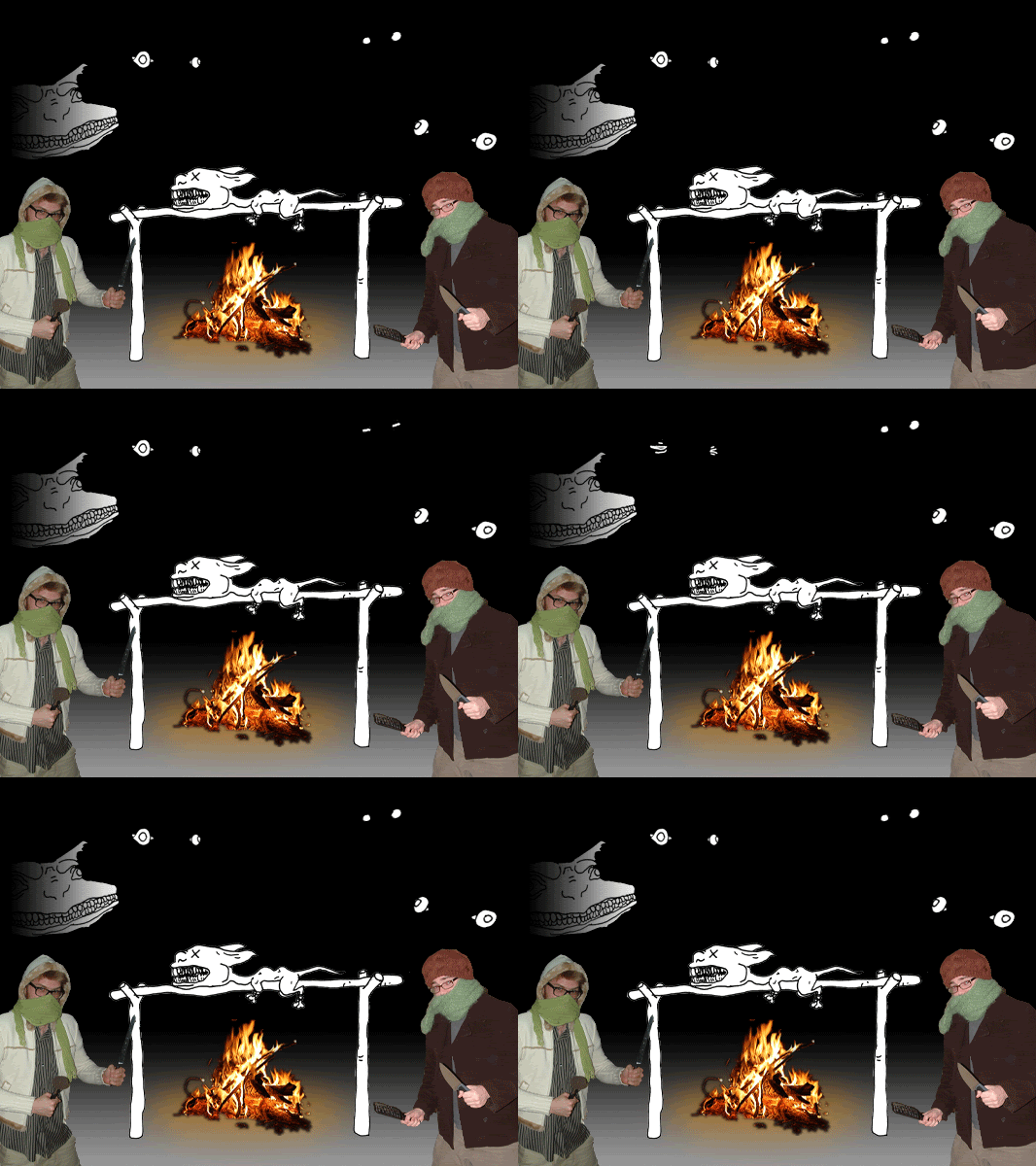
Colin: Hello, and welcome to Unusual Specimens. This is the third and final installment of our exploration of the land of Beigneton and it's most fascinating resident, the Snow Clammal. And when I say fascinating, I mean delicious!
Alex: Most people prefer steamed Clammals, but here we are enjoying a nice spit-roasted one. Catching a Snow Clammal is difficult to do, but well worth the effort. This young one fed us for three days. And it was delicious!
Colin: Some nature documentarians frown on eating their subjects, but Alex and I are of the mindset that we are just as much a part of nature as they. In fact, Alex, I think I heard from a very reliable source that your own mother is a Drill Bird. In fact, I think it was on the bathroom wall in the Winnebago 'O' Science™.
Alex: Thanks, Colin. Well, that concludes another episode of Unusual Specimens, I... wait, I think I heard something.
Sunday, March 1, 2009
Episode #3.2- The Snow Clammal

Alex: Welcome again to "Unusual Specimens," where we get an up-close look at things we don't want to get an up-close look at. I'm your co-host Alex Greenworthingston, and this is the other co-host, Colin Penningsford. This week we're going to continue with our investigation of the Snow Clammal, a resident of Beigneton. I'll let Colin explain to you folks what makes this "specimen" so "unsual." Take it away, Penningsford.
Colin: Thanks Alex. What we're seeing here is the Snow Clammal at rest. Blinky (Unusual Specimens staff photog) is using his special X-Ray camera, or perhaps just his rusty swiss army knife, to give us an EXCLUSIVE look at what exactly is going on inside the Snow Clammal's oral cavity. Due to the frequent snowstorms here in tropical Beigneton, the Clammal often has to take shelter inside it's own mouth to stay warm. Here, you can see that it has prepared itself some tea, the fixings for which it keeps inside a hollow, mug shaped tooth which it then drinks the tea from. But I forget Alex, where does it get the hot water from?
Alex: The Snow Clammal has a modified salivary gland, which heats up to intense temperatures. The real question is where they find the saucer. These clammals can hibernate in this manner for up to 10 months in order to survive Beigneton's fierce blizzard season. After they awake, they become ravenous and consume as much as they can for a few months, until they must hibernate again. Have you ever hibernated for 10 months before, Colin?
Colin: Well, that certainly would explain the amount of time it takes for us to release an episode, wouldn't it Alex? Bah-dum-tchk. Thanks for joining us this week kids, and stay tuned for more Unusual Secimens.
Sunday, February 8, 2009
Episode #3.1- The Snow Clammal
Hello, you have reached the office of Unusual Specimens. Colin Pancrea and Alex Borstein are not in right now. If you would like to leave a message—Colin: HELLO? Hello? Oh hi, I just walked in the door and heard the machine running. Who is this? It’s the kids, Alex. Hi kids. Sorry we’ve been gone for so long, we were out playing laser tag and lost track of time. We’re here in Beigneton, learning about the Snow Clammal. Alex, why don’t you tell the kids a little about this shot you took of this magnificent beast.
Alex: Thanks, Colin. Well, the Munthgiganticus Northimus, or Snow Clammal as it is more commonly known, dwells in the frozen tundra of Beigneton. This remote habitat, as well as its remarkable camouflage, makes sightings extremely rare. Local tribes believe that a sighting of a Snow Clammal bodes well for their luck in video game playing. These creatures can hide under banks of snow for weeks on end, waiting for unwary prey or Blinky, Unusual Specimens staff photog, to pass by. They leap out and engulf snow rabbits, snow foxes, or snow guppies whole.
Colin: Wow, Alex. That’s so interesting that I almost forgot how terrible you are at laser tag.
Alex: Harsh. Eat my shorts. Eat my dust. Eat an egg sandwich. Eat a beet. EETABEET. A little bit. A leetle beet. I’m tired. Goodbye, kids.
Sunday, June 15, 2008
Episode # 2.2: Crowned Berry-Garbler
Alex: Oh, hello there. I didn’t see you come in. My name is Apex Bellhop. Welcome to this installment of Unusual Specimens, the show where we get to take a look at some of Mother Nature’s red headed stepchildren. On this episode we’ll spend some time with Lavandria’s most imposing creature, the Crowned Berry-Garbler. I’ll let my co-host, Coxswain Paneater, tell you a bit about this amazing animal.
Colin: The Crowned Berry-Garbler is an unusual animal in that it begins its life fully grown, and its body grows smaller and more infant like as it gets older. Except for its left arm, which gains some of the mass from their rapidly shrinking body. As toddlers, Crowned Berry-Garblers are about seven feet tall, but a mature Berry-Garbler can be as diminutive as two feet.
Alex: That’s ridiculously informative, Colin.
Colin: Are you being sarcastic? I can’t even tell.
Alex: We start our adventure with a majestic view of the jungles of Lavandria, Garbler in sight. The majestic Crowned Berry Garbler gazes majestically with its majestic eyes upon its majestic territory. Has there ever been a visage as majestic as the Crowned Berry Garbler? Has there, Colin?
Colin: I don’t know, Alex. His face looks kind of like the deformed baby of a taco and a football to me. Anyway, here we have a large, newborn Crowned Berry-Garbler at about six foot eight. You can see the confusion in his eyes, his sense wonder regarding the world around him. Everything is new to this big little guy, his mind a true blank slate.
Colin: Notice if you will, dear viewers, the beautiful flora of the jungles of Lavandria. Lavandria is the only purple jungle in the world, a result of a botched marketing scheme on the part of the Hershey’s Chocolate company. You see, back in the nineteen hundred and eighties Hershey’s was considering adding another color to their popular “M&M’s” line of chocolate candies. The nation went into uproar, and Hershey’s needed to dump the evidence, quick. They flew air carriers out over Lavandria and dumped all the offending candy coating, effectively giving the entire jungle a hard candy shell. At about
Alex: Haha, that’s hilarious. The infamous “Running of the Garbler” is well known to the Lavandrian natives. This photograph perfectly captures the Olympic figure of the Crowned Berry Garbler. The graceful strides of this beautiful creature are indeed hypnotizing.
Alex: Oh my, that looks painful. Viewers should note the careful construction of the Garbler’s nesting site. They only nest in the shallow areas of Lavandria’s premier river, The River of the Jungle of Lavandria. They build the nest out of small twigs, leaves, small mammals, and their own spittle. Because The River of the Jungle of Lavandria floods almost daily nest building is largely an act of futility. Note that if successfully, the top of the nest is lined using only black and white colored materials. This leads many Lavandria adventurers to lose many dominos, newspaper clippings, and dice to the thieving Crowned Berry Garbler.
Colin: Our viewers may be wondering how such a small animal is able to gestate an egg larger than its own body. The answer is simple, although surprising. Crowned Berry-Garblers have an alternate dimension inside their body, about the size of a small
Alex: And I believe that wraps up another episode of Unusual Specimens. You should all feel very fortunate that this was completed in less than one year. Join us next week as we do something else. Maybe Coxswain would like to sign us off of this episode with a catchphrase of his own, then conclude with a snapshot an early explorer holding a newborn Garbler. What say you, Coxswain?
Colin:
Thursday, January 17, 2008
Episode # 2.1: Pandozen-Bellied Honeybeak
Alex: Hello, everyone.
Colin: You’ve joined us this week in the middle of a safari in the far off tropical rainforest of Lavandria. Lavandria, located just east of Peru and just north of Madagascar, is a tropical rainforest fan’s wet nightmare, playing host to some of the most diverse and fascinating flora and fauna this side of the equator! Let’s take a look at some, shall we?
Colin: Woah! Look out, Blinky! [Unusual Specimens staff photog!- Ed.] Boy kids, birds sure do seem to love Blinky. You would think that his head looks like a wriggling, juicy earthworm! Actually, now that you mention it…Alex: This is an awfully blurry photograph to start out on. This bird flies through the trees of Lavandria searching for its primary food source, monkey eyeballs. Adventurers going on safari in the jungles of Levandria would do well to invest in some protective eyewear, as Blinky obviously discovered the hard way.
Alex: Here we see many Pandozen-bellied Honeybeaks at rest in its natural breeding grounds. Mature Pandozen-bellied Honeybeaks travel over 2 km every breeding season to reach the very area in which they were conceived. They are world renowned for having the shortest migration ever. Adventurers gather at these breeding sites at the appropriate time to witness this impressive event.Colin: Note how the Pandozen-bellied Honeybeak does not cast a reflection into the water below it. This is due to the hue of the Pandozen-bellied Honeybeak’s plumage. It is the only animal in the world that sports the color Pandozen. Which, as we all know, light passes right through. And boy, just look at this beautiful, serene scene. The playful gaze of the Pandozen-bellied Honeybeak into the camera lens. The way the two Pandozen-bellied Honeybeaks in love snuggle up against one another on the log. The way the dead Pandozen-bellied Honeybeak in the lower right hand corner still seems to have so much spirit in it. You know, after so many years of studying nothing but grotesque, repulsive abominations of nature, it sure is nice to take a look at someth-
Colin: OH MY GOD what is happening! Alex, explain it away with your science so that I don’t have to fear it anymore!Alex: It looks like the mating ceremony has begun. Every Pandozen-bellied Honeybeak emits a high pitched, horrible screeching noise similar to nails on a chalkboard amplified several thousand times. This part of the mating ceremony lasts for a full lunar cycle. At the larger breeding sites this noise has been known to rupture eardrums and cause permanent ear damage from as far away as 5 km. It’s a good thing that Blinky had earplugs since he was this close, right? He had some, didn’t he?
Colin: Whew! Thanks for that enthralling explanation, Alex. You’ve surely rescued me from no less than a fortnight of nightmares. For further scientific analysis, I whipped out my celly and shot this vid of the creature in mid transformation.
Alex: If you would like to purchase an individual copy of this program installment in VHS or DVD format, please send $50.00 in small bills and a SASE to:
Unusual Specimens
PO Box 717
Utica, NY 13502
Please include the episode name in your order.
Friday, July 6, 2007
Episode # 1.2: The Slish
Alex: This exotic fish has actually evolved a way to exist outside of a body of water. In fact, no Slish has ever been found in water, ever! How crazy is that? They are able to swim through sand much like their aqua-borne cousins, regular fish. They are a common sight along the dunes of South Kik Yo’Butte, but still a food source has not been identified. Very strange, indeed.Colin: Please forgive our idiot graphic designer, who when applying the iron-on graphics to this photograph, misspelled “Slish”, “Sish”.
Alex: Our photographer has captured the Slish during one of their favorite pastimes, jumping out of the sand and exclaiming, “Hwuh!” This majestic sound carries far over the barren dunes, perhaps catching the attention of a flock of Drill Birds.
Alex: Life in the desert is a harsh one. Somehow Blinky [Unusual Specimens staff photog!- Ed.] was able to catch both the signature Slish head as well as some sort of ghost fish behind it. Slish predators are numerous, and conditions are harsh. The Drill Bird is in fact, the main Slish predator. Using its powerful Death Spin technique, the Drill Bird is able to decimate small schools of Slish.
Colin: That’s great Alex! I don’t think I’ll ever figure out how you got all of that creamed corn out of her pockets.
Colin: This helpless little Slish has been taken from the warm inviting embrace of its sandy habitat and is lying helplessly on our “Unusual Specimens Examination Table”™. Notice how it calls out for help from its brothers, who can he heard flinging themselves into the sides of our “Winnebago ‘O’ Science”™ in a hilariously futile rescue attempt.
Click here to listen!
Colin: Dis-gusting!
Alex: Slish normally grow up to be between 2-4 inches long. So I have no idea how big this tiny man must be. This is astounding. What a tiny man! I can’t believe it!
Thursday, June 14, 2007
Episode # 1.1: The Drill Bird
Alex: I’m very glad to be here, Colin.
Colin: Now docile viewers, science textbooks may have fooled you into thinking that we have every form of life on this planet documented, but don’t listen to them. They’re just trying to sound smart. There are entire islands and regions that humans have never even set foot on, let alone catalogued the myriad of its fauna. Today we are showing you our discoveries from the far away desert terrain of South Kis M’Bhutte. Let’s see what magical creatures it holds, shall we?
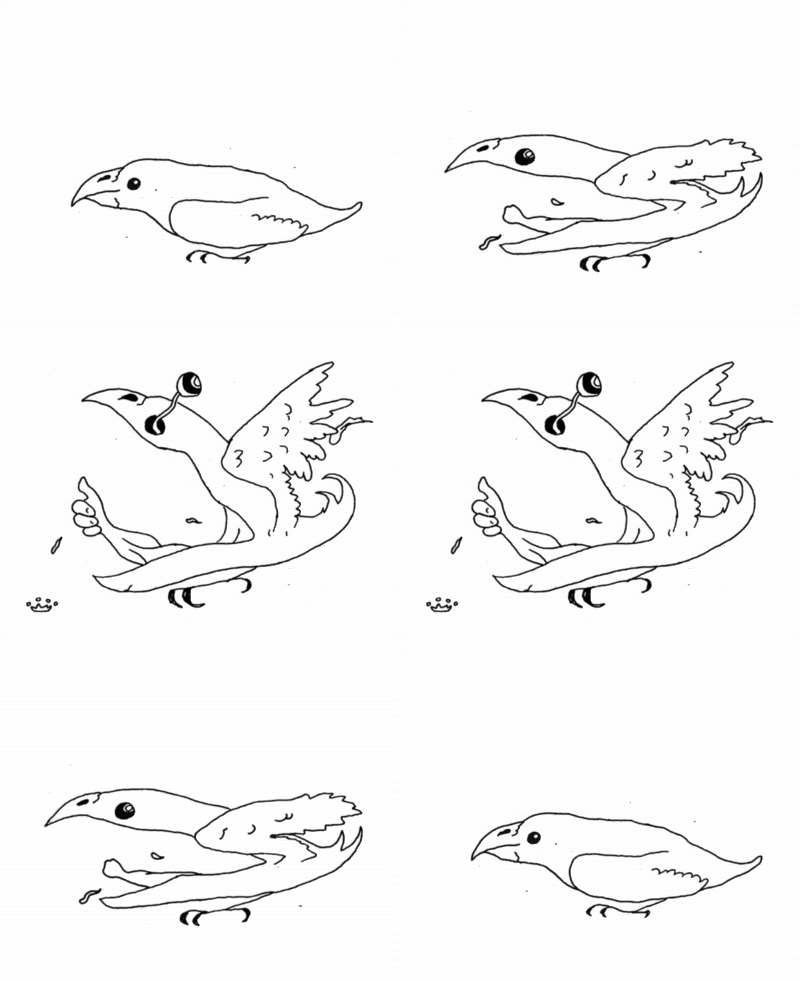
Colin: This is the Drill Bird of South Kis M’Bhutte. Although his boney, frail wings look useless, he is more than capable of flight, as we’ll see later. His plumage is ruffled and sickly looking, as a result of generations of the species making their home in the harsh desert landscape of South Kis M’Bhutte. The above photograph is of a Drill Bird emitting his “Death Cry”. The “Death Cry” is used by Drill Birds when they spot intended prey, and also when they score under a “B” on their report cards. Notice the small spikes visible all over its body, the function of which will be discussed later.
Alex:
Colin: Here we see a Drill Bird in mid-“Death Spiral”. Now, what’s happened here is the Drill Bird has spotted its prey and is dive bombing to intercept its path. The “Death Spiral” is rarely successful as the Drill Bird continues it’s “Death Cry” throughout, the volume and grating-ness of which ruins any chance for a surprise attack. As implied by its name, the “Death Spiral” is more than just a straightforward dive-bomb. In real life it looks, in fact, as if Deon Sanders himself has hucked the tiny, frail bird into a perfect spiral. Now is a good time to notice the majesty of this winged creature as it hurdles toward its prey. In fact, trusted Unusual Specimens staff photographer Blinky had better move out of the path of this Drill Bird’s “Death Spiral” if he hopes to live to photograph any of Kis M’Bhutte’s other majestic creatures! Watch out, Blinky!
Alex: This is truly a frightening sight to behold! I applaud Blinky’s commitment to nature photography. He is willing to sacrifice even himself for the perfect photograph. You should take this time to observe the Drill Birds eyes in this photograph. They are literally popping out of their sockets. Such is the force of the spin that Drill Birds are capable of.
Alex: There is not much to say here. This is the impact of the Drill Bird on the sandy soil. As you will soon see, the Drill Bird utilizes the forward momentum of the “Death Spiral” to begin its burrow. It often uses this technique to catch prey or escape from predators. Notice the desolate landscape of South Kis M’Butte. Not a thing in sight!
Colin: I smell.
Colin: Here we’ve used a special sand-proof camera, the “Sand Peeper”, to give you an “in-sand-view” of an actual Drill Bird burrowing through the sand. Notice the steely determination in his eyes, the almost frightening resolve in the power of his legs kicking him forward, aided by the spikes poking out of his body, spinning him deeper and deeper through the sand. Just before he enters into the sand the Drill Bird starts weeping uncontrollably. His “tears” are actually a mucus that hardens and protects his eyes from the tiny sand particles, which would otherwise cut them to ribbons. This mucus was considered a delicacy by local natives, who would harvest it and spread it on toast on the occasion of their sixteenth birthday, after which they would die, as the mucus is highly toxic.
Alex: Yes, it’s true, the Drill Bird holds a high standing among the natives. I myself have tasted the eye mucus of the Drill Bird and have found it to be pleasantly strong, not unlike a ripe truffle.
Colin: Thanks to you at home for braving the harsh desert heat and lack of indoor plumbing to be here with us here today in South Kis M’Butte. I know I’ll be taking no less than three showers on the way home in our “Winnebago ‘O’ Science”™ to make myself suitable to bed with my wife, Ludmilla. Anyway, thanks for tuning in this week and joining us in our raid of nature’s proverbial treasure chest, faithful viewers. Remember, if you find any new forms of life, take a photo and send it in to us… we could show it on the air! And stay tuned to Hot Wax Mealworms for future installments of Unusual Specimens. Tell the people goodbye with your famous signing-off catchphrase, Alex!
Alex: Can I go home now?